
Home › Cleaning Business Insurance Guides › Cleaning Chemicals, OSHA HazCom & Your Liability
Cleaning chemicals, OSHA rules and your liability
If your crews use hazardous cleaning chemicals, OSHA expects a written program, safety data sheets, labels and training. When something still goes wrong, a burned worker usually goes to workers' comp. A ruined floor or a sick tenant goes to general liability, where the pollution wording decides a lot. Here's how the rules and the policies fit, with OSHA as the final word on compliance.
Key takeaways
- OSHA's Hazard Communication Standard (29 CFR 1910.1200) applies when your employees work with hazardous chemicals. It calls for a written program, a chemical list, safety data sheets your crews can reach on every shift, labeled containers and training before first use.
- The Bloodborne Pathogens Standard (1910.1030) applies only where contact with blood is reasonably expected as part of the job. OSHA generally doesn't treat janitors in non-medical buildings as exposed, but the employer has to look at each job and task.
- Disinfectants are EPA-registered pesticides, and EPA treats the label as legally binding.
- A crew member's chemical burn usually lands on workers' comp. A ruined client floor or a tenant made sick by fumes lands on general liability, where the pollution exclusion and any endorsements can decide the outcome. Courts in different states read that exclusion differently.
- Contractors pollution liability can fill gaps your general liability leaves, but forms differ, so ask what yours covers in writing.
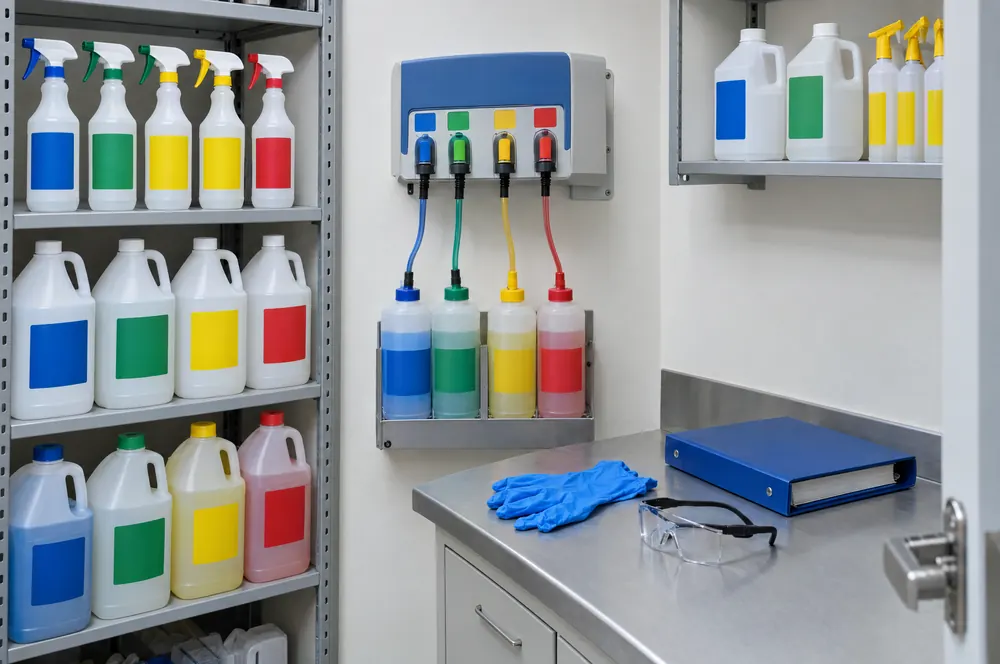
What OSHA's Hazard Communication Standard expects from a cleaning company
If your workers use hazardous chemicals on the job, the Hazard Communication Standard (HazCom) puts duties on you. They're yours as the employer, not just the maker's. They come in four parts: a written program, labels, safety data sheets (SDS) and training.
OSHA doesn't set its own requirements for cleaning products. HazCom makes the maker sort out each product's hazards. Then that hazard information has to reach the workers who use it.
The four pieces OSHA looks for
- A written hazard communication program. It explains how you handle labels, SDSs and training, and it lists the hazardous chemicals you use by the same product name that appears on each SDS.
- Safety data sheets. You keep an SDS for each hazardous chemical, and your crews must be able to reach it during every shift. Electronic access is allowed if it puts no barrier between a worker and the sheet. For crews that move between buildings during a shift, the sheets may stay at your main location, as long as workers can get the information right away in an emergency.
- Labels. Containers of hazardous chemicals in the workplace need a label with the product name and its hazards. The rule has a narrow exception for a portable container meant only for the immediate use of the worker who filled it.
- Training. Workers get trained when they're first assigned and again whenever a new chemical hazard enters their work area. OSHA and NIOSH add that training has to be in a language and vocabulary the worker understands.
Working inside someone else's building
Night crews work in buildings full of other employers' people. When your chemicals could reach another employer's workers, your written program has to cover them. It explains how they get your SDSs, what steps they should take to stay safe and how your labels work.
That's one reason a facility manager may ask for a copy of your SDS binder before your start date.
The consumer product exemption is narrower than it looks
HazCom exempts consumer products, but only in narrow cases. The product has to be used the way the maker intended. And workers can't use it longer or more often than a shopper would at home.
In a 2005 letter, OSHA applied it to office staff who wipe their own desks now and then. It said the employer must judge the real exposure. A porter using the same glass cleaner all shift is a different case, so check OSHA's guidance before you rely on it.
Dates to know in 2026
OSHA updated HazCom in 2024, and the new version took effect July 19, 2024. Under the current text, employers must update workplace labels, the written program and training as needed for newly found hazards. The deadline is November 20, 2026 for single substances and May 19, 2028 for mixtures. A January 2026 rule pushed those dates back.
Expect updated SDSs from your suppliers as makers reclassify products.
HazCom is also one of the rules OSHA cites most. It ranked second on OSHA's preliminary list for fiscal year 2026 (October 2025 through August 2026).
Some states run their own OSHA programs, which must be at least as strong as the federal one. In California, the matching rule is Title 8, section 5194.
In California, Michigan and North Carolina, among other states, a state agency enforces these rules for private employers. For the full rule text, start at OSHA's Hazard Communication page.
When the Bloodborne Pathogens Standard reaches a janitorial crew
The Bloodborne Pathogens Standard kicks in only where a worker can "reasonably" be expected to touch blood or other infectious material at work. The employer applies that test job by job.
In a 1992 letter, OSHA said it doesn't usually see janitors in non-medical buildings as exposed. But the same letter put the burden on the employer to decide which jobs and tasks are. And it said OSHA can find exposure case by case.
A second 1992 letter said housekeeping workers in healthcare settings may be exposed.
So if your crews clean exam rooms, empty sharps containers or service restrooms in clinics, look at those tasks against the rule. Our page on medical office and clinic cleaning insurance covers the insurance side.
Where the standard does apply, it requires:
- a written exposure control plan, reviewed at least once a year
- the hepatitis B vaccine series offered at no cost within 10 working days of the first assignment
- training at assignment and at least yearly after that
- protective equipment provided at no cost to the worker
- a written schedule for cleaning and decontamination
OSHA's standard is the place to confirm what applies to your crews: 29 CFR 1910.1030.
EPA-registered disinfectants and the label
To EPA, a disinfectant is a kind of pesticide: one that kills germs on hard surfaces. EPA regulates them. It says more than 4,000 antimicrobial products, the group that includes disinfectants and sanitizers, are registered with it.
EPA says the label on a pesticide is the law. Each label warns that using the product in a way it doesn't allow breaks federal law.
Underwriters for clinic and school accounts may ask which disinfectants you use. Have the product names and EPA numbers ready when you ask for a quote. EPA's guide to pesticide labels explains how to read one.
Where a chemical incident lands on your insurance
Who got hurt and whose property broke usually decide which policy goes first. These are typical patterns, not promises. Your policy wording and your state's courts decide the outcome.
| What happened | Policy that usually responds | What to check |
|---|---|---|
| A crew member splashes concentrate in her eyes while filling bottles | Workers' comp | Payroll reported in the right class code |
| A worker reports breathing trouble after months on floor-care routes | Workers' comp | How your state handles illness claims |
| A stripping job etches a lobby's marble | General liability, if no exclusion applies | The "property you are working on" exclusion |
| A tenant slips on residue the morning after your crew leaves | General liability, often as completed operations | Your completed-operations aggregate limit |
| Fumes drift into a tenant's suite and an employee there needs treatment | General liability, subject to the pollution exclusion | Total pollution endorsements |
| A container leaks in a storage closet and runs into a floor drain | General liability may exclude it | Contractors pollution liability |
Workers' comp: burns and breathing problems
Chemical injuries to your own crew usually go through workers' comp for cleaning companies. OSHA and NIOSH list the common ones. Some cleaners can cause severe burns to skin and eyes. Vapors can irritate the eyes, nose, throat and lungs. Some products can cause asthma or set off an attack. And mixing bleach and ammonia products can cause severe lung damage or death.
Example scenario: A new hire on a 3x weekly route refills a spray bottle in a client's janitor closet. The jug slips, and she takes a splash across her face. Her emergency visit and lost shifts would normally be a comp claim. In Ohio, that comp comes from the state fund, not a private carrier.
Comp premium follows payroll by class code, so our guide to janitorial class codes and audits is worth a read.
General liability: client surfaces and the people in the building
General liability pays when someone outside your company is hurt or their property is damaged. Two standard exclusions matter here. One removes damage to the exact part of a building you're working on when your work causes it. The other removes personal property in your care, custody or control. That means things you're handling or in charge of at the time.
A stripper that etches the exact floor you're refinishing can fall into that first gap. Our page on client property and care, custody and control coverage explains the options some carriers offer.
Example scenario: A crew scrubs and recoats a law office's break room on a Friday night. Fumes travel through a shared return vent. On Saturday morning, a paralegal working overtime in the next suite has an asthma attack. She makes an injury claim against you, and the pollution exclusion is where the fight starts.
The pollution exclusion and cleaning chemicals
The standard liability form has a wide definition of "pollutants." It means any solid, liquid, gas or thermal irritant or contaminant. It names fumes, vapor, acids, alkalis and chemicals.
Read literally, that sweeps in most of a janitor's cart. But the exclusion is written in parts.
The exception cleaners care about
One part of the exclusion removes pollutants you bring to a job site while you work there. That part has an exception. It gives back coverage for harm inside a building from gases, fumes or vapors. The source has to be products you brought into that building for your work.
For the paralegal in the example, that's where the coverage argument would begin.
Many contractor policies swap those parts for a "total pollution exclusion." It's added by an endorsement, a form that changes the policy. The strictest version, ISO form CG 21 49, has no exceptions at all, so the fumes exception is gone.
Two quotes with the same limits can treat a fumes claim very differently.
Courts don't agree
State courts split on how far the exclusion reaches:
- Washington, 2005: a tenant was overcome by fumes after a contractor sealed a nearby deck. The state supreme court applied the absolute pollution exclusion as written.
- California, 2003: a tenant died after her landlord had the building sprayed for yellow jackets, and her family sued. The state supreme court held the exclusion didn't plainly and clearly cover ordinary negligence with toxic chemicals like pesticides, so it was read in favor of coverage.
- Illinois, 1997: the state supreme court limited the exclusion to traditional environmental pollution in a case about a furnace leaking carbon monoxide into a commercial building.
The same fumes claim could go one way in Seattle and another in Los Angeles.
Where contractors pollution liability fits
Contractors pollution liability (CPL) is its own policy, though some carriers fold it into a combined one. It's for pollution your work causes or makes worse. It usually responds to injury, property damage, defense costs and cleanup.
Forms vary. Some are occurrence forms. Others are claims-made, which need an unbroken retroactive date. Ask in writing whether the form you're quoted covers fumes in an occupied building, spills and drain discharge. If an insurance exhibit in an RFP lists a pollution limit, our pollution and chemical liability page walks through what to send back.
How chemical use shows up in your quote
- The quote form asks whether you use or handle chemical cleaning products and, if so, what share of your operation involves chemical handling.
- A licensed agent follows up on what's on your carts: dilution systems, floor strippers, disinfectants, where you store product and whether you keep stock at client sites.
- We read the pollution wording on each general liability quote, including any total pollution endorsement, and show you the differences side by side.
- We price contractors pollution liability when your work or your contracts point to it, and explain what each form leaves out.
Your price depends on the payroll in each class code, your annual sales, the kinds of buildings you clean, how much specialty and chemical work you do, the vehicles your crews drive, your claims history and the limits your contracts require. When you're ready, start your quote.
Questions to bring to your next renewal
Ask these before bid season, not after a claim:
- Does my general liability carry a total pollution exclusion? Which form number?
- Is the exception for fumes inside a building still on my policy?
- How would my policy treat damage to a floor we were stripping when it happened?
- Is my contractors pollution policy occurrence or claims-made, and what's the retroactive date?
- Is my comp payroll split into the right class codes for porters, floor techs and supervisors?
- Do any of my contracts require pollution limits or additional insured status on a pollution policy?
If you're answering an RFP right now, our guide to contract insurance requirements shows how buyers spell these out.
Frequently asked questions
What are the OSHA regulations regarding cleaning chemicals?
Are cleaning products considered hazardous chemicals?
Do I need an SDS for cleaning products?
What is exempt from SDS?
Do all chemicals fall under the hazard communication rule?
Want a second set of eyes on your coverage?
Independent agents, 12+ A-rated carriers, and a licensed agent back to you within one business day.