
Home › Coverages › Industrial & Warehouse Cleaning Insurance
Insurance for industrial and warehouse cleaning
Industrial cleaning insurance covers the janitorial work you do inside plants, warehouses and distribution centers, where the machines are bigger, the chemicals stronger and the client's inventory sits a few feet from your scrubber. It's built on the same liability, comp and equipment coverage as office work, with more attention to pollution wording and to what the plant's contractor rules require.
- Since 2003
- 12+ A-rated carriers
- 28 states
- Independent agents
Start your cleaning business insurance quote
Takes about two minutes. A licensed agent follows up.
Licensed in 28 states · NPN 7642818 · Since 2003
How underwriters read industrial cleaning insurance applications
An underwriter sees a plant or warehouse account as janitorial work in a heavier setting. Your crews still empty trash, clean restrooms and locker rooms, and scrub floors. But they do it around forklifts, racking, production lines and loading docks, often on a second or third shift while the plant is running. That timing matters. A crew cleaning an empty office tower at midnight sees few people. A crew scrubbing a warehouse aisle at midnight may share it with order pickers, forklift drivers and a shift supervisor who wants the aisle back in twenty minutes.
The questions on the application get more specific:
- Where in the facility you work. Offices, break rooms and restrooms read like any office account. Production floors, warehouse aisles and shipping docks bring traffic, heavier soil and bigger machines.
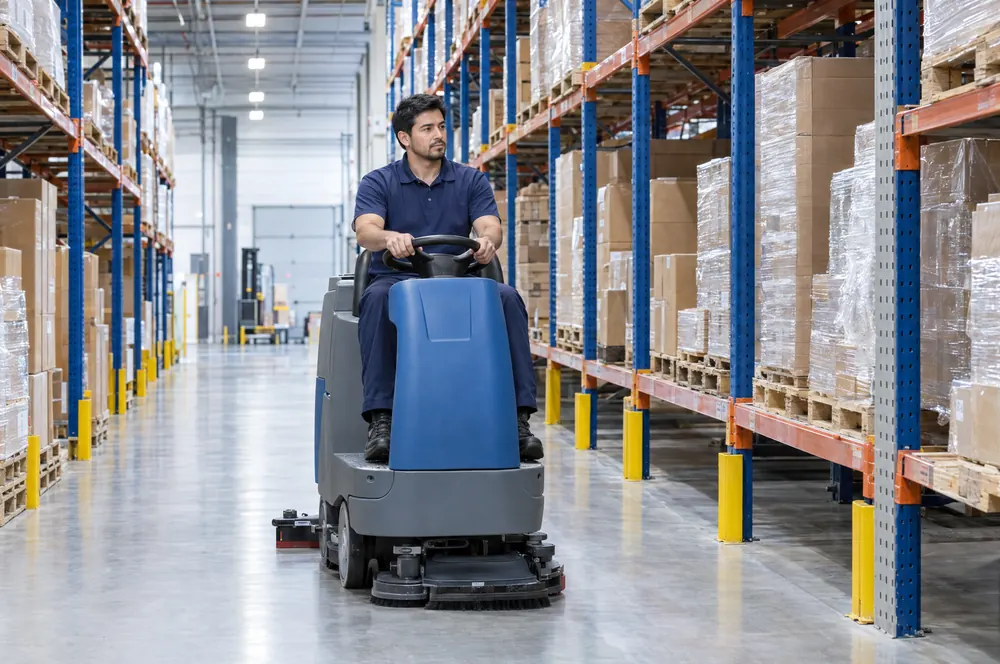
- What you run. A walk-behind scrubber in an office lobby and a ride-on auto-scrubber in a 400,000-square-foot distribution center are priced differently, on your liability and on your equipment floater.
- What you use. Degreasers and heavy-duty floor cleaners are often stronger than office products. Hazardous chemicals bring OSHA's hazard communication rules into play and make the pollution wording on your policy matter more.
- How high you go. High dusting on ladders and lifts around pipes, ducts and fixtures raises the comp exposure for your crew.
- What else you do. NCCI's janitorial comp class can include minor upkeep, like painting or changing light bulbs, when your crews also clean that building. Maintenance, painting or repair at a site where you don't clean is rated separately, and so are structural alterations and rewiring. Tell us about that work before an audit finds it.
Example scenario: the rack upright at 2 a.m.
An operator on a ride-on auto-scrubber clips a pallet rack upright while cleaning an aisle in a distribution center. The upright bends, a pallet shifts, and cartons of the client's stock fall to the floor. The client's damaged product and rack repair would usually go to your general liability policy, since neither was the surface you were cleaning. Damage to the scrubber itself is a question for your equipment floater, not your liability policy.
Example scenario: the mop water behind the dock
At the end of a Sunday night shift, a crew member empties a bucket of degreaser solution into the storm drain behind a plant's loading dock. The plant gets a notice about the discharge and asks your company to pay for the response. A claim like that can run straight into the pollution exclusion on a liability policy. Contractors pollution liability is written for this kind of release.
Example scenario: the overhead pipes
A crew member high-dusting the overhead pipes in a machine shop's break area falls from a stepladder and breaks his wrist. His treatment and lost wages would usually go to workers' comp. If the plant's contract asked you to waive subrogation, your comp policy needs a waiver endorsement for that to work.
The coverage stack for plant and warehouse accounts
Industrial accounts lean harder on four policies than an office route does: liability, comp, equipment and pollution.
General liability
Answers damage to a client's stock, racking and equipment, and injuries to plant employees and visitors. General liability for cleaning companies
Workers' comp
Ladders, lifts, ride-on machines and stronger chemicals all show up in crew injury claims. Workers' comp for cleaning crews
Equipment
Ride-on scrubbers and sweepers kept at the plant often cost more than blanket equipment limits. Equipment coverage for cleaning companies
Pollution and chemical liability
Spills reaching a drain, fumes in a closed area and mixing incidents can fall outside general liability. Chemical liability coverage
Commercial auto
Crews often drive to industrial parks on the edge of town at night, in company vans or their own cars. Auto coverage for cleaning companies
Umbrella
Extra liability limits for the plant or logistics contract that names a figure above your base policies. Umbrella insurance
What plants and distribution centers ask for
Manufacturers and logistics companies usually run every outside contractor through the same vendor process, whether it's an electrician or a cleaning crew. Expect a packet that asks for some of these:
- A certificate before the first shift, with the plant, and sometimes its parent company and landlord, as additional insured.
- A waiver of subrogation on general liability and workers' comp. The comp waiver is a separate endorsement on the comp policy.
- Proof of workers' comp, even in states where a small employer might not otherwise need it.
- Safety paperwork, such as your hazard communication program, chemical list and training records. Some plants also ask for your experience modification factor on comp.
- Site orientation for each crew member before they're allowed on the floor.
Comp certificates are often the line a plant won't bend on, and state law explains why. In Indiana, for example, a business that contracts for more than $1,000 of work without getting a certificate from the state's Worker's Compensation Board showing the contractor has complied with the comp law can be held liable, to the same extent as the contractor, for comp owed to that contractor's injured employees.
Ohio works differently: employers there pay comp premium into the state insurance fund run by the Bureau of Workers' Compensation unless they're approved to self-insure. Plants expect to see BWC proof of coverage, not a private carrier's certificate.
Badges, gates and alarm panels
Plants rarely hand a cleaning crew a simple key ring. Your supervisors may carry access badges, gate codes and the alarm code for an office wing. Lost-key coverage, where you have it, is an optional add-on, and some wordings mention only keys and locks. Ask whether yours would pay to reissue badges or reprogram readers, and keep a sign-out log for every credential. Underwriters and plant security teams both tend to ask about it.
Growing in plants and warehouses
Most cleaning companies come into industrial work through the front office. You clean the plant's offices and restrooms for a year, then the facility manager asks whether you can take on the break rooms, locker rooms and finally the warehouse floor.
Each step changes something:
- Production and warehouse floors bring ride-on machines, heavier chemicals and night work around moving equipment. Tell your carrier before you start, not at renewal.
- A second shift at the same site adds payroll. Raise your comp estimate when you add it, so the audit doesn't arrive with a large bill.
- A second plant for the same company often means a master agreement with higher limits and an umbrella.
- Your own ride-on machine belongs on your equipment schedule the week you buy it.
Your price depends on the payroll in each class code, your annual sales, the kinds of buildings you clean, how much specialty and chemical work you do, the vehicles your crews drive, your claims history and the limits your contracts require.
If a plant's vendor packet is sitting on your desk, send it with your quote request. Our team will go through each line with you. Get a quote for your cleaning business →
Industrial cleaning insurance questions
Is industrial cleaning insurance different from janitorial insurance?
Does my general liability cover damage to a warehouse client's inventory?
Do I need pollution coverage to clean a manufacturing plant?
Is my ride-on scrubber covered at the client's plant?
Why does the plant want a waiver of subrogation?
Related pages
Ready to see what you'd pay?
Independent agents, 12+ A-rated carriers, and a licensed agent back to you within one business day.