
Home › Coverages › Carpet, Floor & Window Cleaning Insurance
Insurance for carpet, floor care and ground-level window cleaning
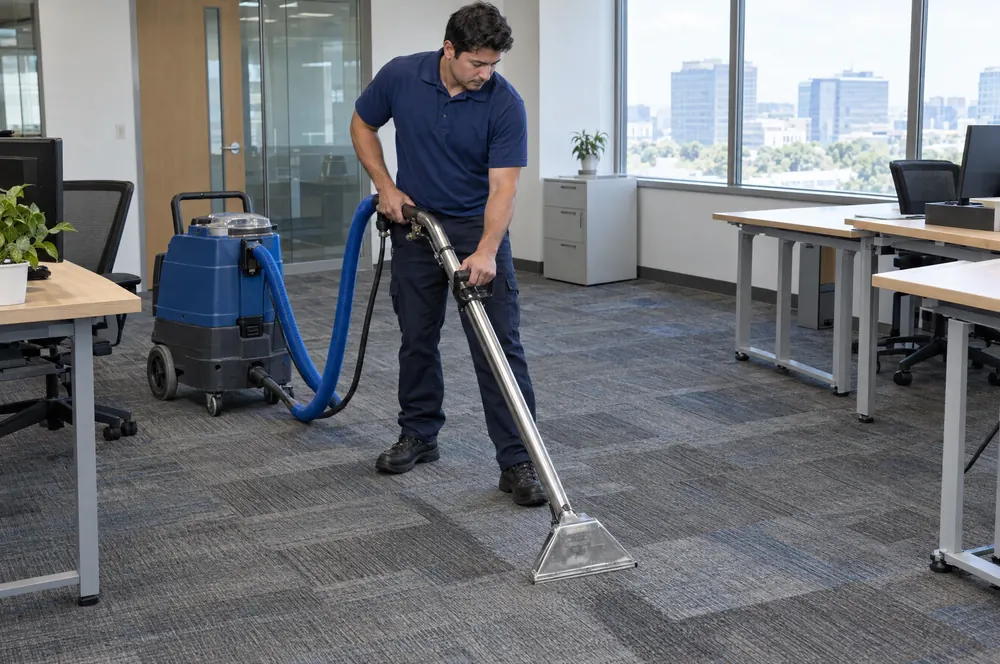
Carpet cleaning insurance for a commercial cleaning company usually isn't a separate policy. It's your general liability, comp and equipment coverage, written to include the extraction, floor refinishing, ground-level window work and post-construction cleanup you add to your route. What changes is the surface damage you can cause, the machines you carry and how carriers class the extra sales.
- Since 2003
- 12+ A-rated carriers
- 28 states
- Independent agents
Start your cleaning business insurance quote
Takes about two minutes. A licensed agent follows up.
Licensed in 28 states · NPN 7642818 · Since 2003
Carpet cleaning insurance and other add-on services, as underwriters see them
Most commercial cleaning companies don't start out offering carpet, floor or window work. They add it. A property manager asks for carpet extraction in a tenant suite, a school wants its floors stripped over break, a new retail space needs cleanup before opening. Underwriters treat these as services layered on top of your janitorial work, and they want to know how big each layer is.
Four things stand out when these services show up on an application:
- Service mix. Carriers usually rate the core of your business in the janitorial class and may rate carpet, floor waxing or window work separately when they're a meaningful share of sales. Many janitorial programs cap how much side work they'll accept under one rate.
- Surface risk. Extraction can overwet a carpet. Strippers can etch stone or lift a wood finish. A scraper can scratch glass. These are the claims that test your policy's exclusions.
- Machines and vehicles. Portable extractors, burnishers and auto-scrubbers ride in your van and sometimes stay at the job. Some companies run a truck-mounted extraction unit built into the vehicle.
- Chemicals in transit and in use. Concentrated floor strippers and some carpet pre-sprays are stronger than daily janitorial products, and some concentrated corrosives are regulated when you carry them.
A note on that last point. Federal rules let a business carry limited amounts of some regulated products for its own work under the "materials of trade" exception, with limits on each container and a 440-pound cap on the total in the vehicle, and containers that are closed, secured and marked with the product's name. A jug of stripper that splits in a hot van can hurt someone and damage property. Check each product's safety data sheet and PHMSA's guidance; we don't give transport compliance advice.
Example scenario: the credit union carpet
A crew extracts the carpet in a credit union branch on a Saturday night. Too much solution goes down near the teller line, and over the next week the carpet shrinks away from the wall and the seams open. The branch wants the carpet replaced. Because the crew was working on that exact carpet, the standard exclusions for the part of a building you were working on, or work done incorrectly on it, may apply. A care, custody and control buy-back, where you have one, is the place to look.
Example scenario: the showroom floor that stayed soft
A crew strips and refinishes a furniture showroom's vinyl tile overnight and lays the coats down too close together. The finish is still soft when the doors open, and a customer slides and falls by the entry at 10 a.m. Because the work was finished and the floor was back in use, the claim may fall under the products-completed operations hazard of your general liability policy, which has its own aggregate limit.
Example scenario: scratches on new storefront glass
A crew does the final clean on a new restaurant before opening day. Removing paint flecks and labels with a scraper leaves arcs of fine scratches across two ground-floor storefront panes. The general contractor holds back your payment until the glass is replaced. Whether liability coverage responds can turn on the same exclusions for the property you were working on, and on your contract's wording.
The coverage stack for specialty services
Specialty services don't need a separate set of policies. They need the policies you have to be written for the work you actually do.
General liability
The policy that answers surface damage beyond what you were cleaning, and injuries after a floor job. General liability for cleaning companies
Client property
An optional buy-back can restore some coverage for property in your care that standard forms exclude. Client property coverage
Equipment
Extractors, burnishers and scrubbers, at the job, in the van or stored at a client's site. Equipment coverage
Commercial auto
Covers the van and its equipment, which may include a truck-mounted unit built into it. Commercial auto for cleaning companies
Workers' comp
Crews doing extraction and strip-and-wax work handle heavier machines and stronger chemicals. Workers' comp for cleaning crews
Pollution and chemical liability
Stripper fumes in a closed suite or a chemical spill can run into a liability policy's pollution exclusion. Chemical liability coverage
What clients ask for on specialty projects
Specialty work is often project-based, so the paperwork arrives fast and for each job. Expect two kinds of buyers.
Property and facility managers
A carpet or floor project in an existing building usually follows the same terms as your nightly contract: a certificate naming the owner and management company, additional insured status, and sometimes a waiver of subrogation. Some managers want the certificate before they'll schedule the weekend. If your regular contract already requires those endorsements, check that the project is covered by the same wording.
General contractors on post-construction cleanup
Final cleans before a building opens come under a subcontract with a builder. That changes the paperwork. Builders commonly ask for additional insured status for ongoing and completed operations, on a primary and non-contributory basis, plus waivers on liability and comp. ISO's automatic additional insured endorsement for contractors, CG 20 38, is titled for written construction agreements and covers ongoing work only. Completed-operations status takes a separate endorsement, such as CG 20 37. Ask whether your blanket wording fits a builder's subcontract as well as your janitorial service agreements.
Our guide to certificates and endorsements breaks down each piece. Get a quote for your cleaning business →
Adding specialty services without outgrowing your policy
The safest time to add a service is before you sell it. Here's how growth usually goes:
- First carpet or strip-and-wax job. Tell your carrier, and check whether your program allows the service and at what share of sales.
- Buying an extractor or burnisher. Add it to your equipment schedule at its replacement value. If you install a truck-mounted unit, make sure the vehicle is on a commercial auto policy and listed with the unit.
- Hiring a floor tech. Comp is priced on payroll by class, so keep floor and carpet payroll records clear for the audit. The guide to janitorial comp codes and audits explains how.
- Post-construction work. Builders' subcontracts bring new endorsements. Line them up before you sign. If your crews haul away construction debris, NCCI doesn't count that as janitorial work; it's rated under Code 5610.
- Renewal. Update your sales split each year. A carpet line that grew from 10% to 40% of sales can change your rating.
Your price depends on the payroll in each class code, your annual sales, the kinds of buildings you clean, how much specialty and chemical work you do, the vehicles your crews drive, your claims history and the limits your contracts require.
Tell us which services you offer today and which you plan to add this year, and our team will check which programs fit the mix. Get a quote for your cleaning business →
Carpet, floor and window cleaning insurance questions
Do I need separate insurance for carpet cleaning?
Does general liability cover a carpet we damage while cleaning it?
What insurance do I need for window cleaning?
Is floor stripping covered by my janitorial policy?
Is my truck-mounted carpet extractor covered by auto insurance?
Related pages
Ready to see what you'd pay?
Independent agents, 12+ A-rated carriers, and a licensed agent back to you within one business day.