
Home › Coverages › School & Campus Cleaning Contractor Insurance
Insurance for school and campus cleaning contractors
School cleaning insurance is the general liability, workers' comp, bond and auto coverage a district or campus writes into its custodial contract, usually with endorsements spelled out and certificates due before the first shift. Background checks for your crew are often required too, and the rules change from state to state.
- Since 2003
- 12+ A-rated carriers
- 28 states
- Independent agents
Start your cleaning business insurance quote
Takes about two minutes. A licensed agent follows up.
Licensed in 28 states · NPN 7642818 · Since 2003
What school cleaning insurance looks like to an underwriter
Schools are some of the most predictable accounts a cleaning company can win and some of the most demanding to insure. The buildings are big, the contracts run for years, and the buyer is usually a public body with an insurance exhibit nobody can waive. Underwriters look at four things.
- Who's in the building while you work. An evening crew that starts after dismissal is a different risk from a day custodian working in hallways full of students.
- Square footage and payroll. A high school or a campus can add more payroll in one award than a year of office accounts. Comp is priced on that payroll.
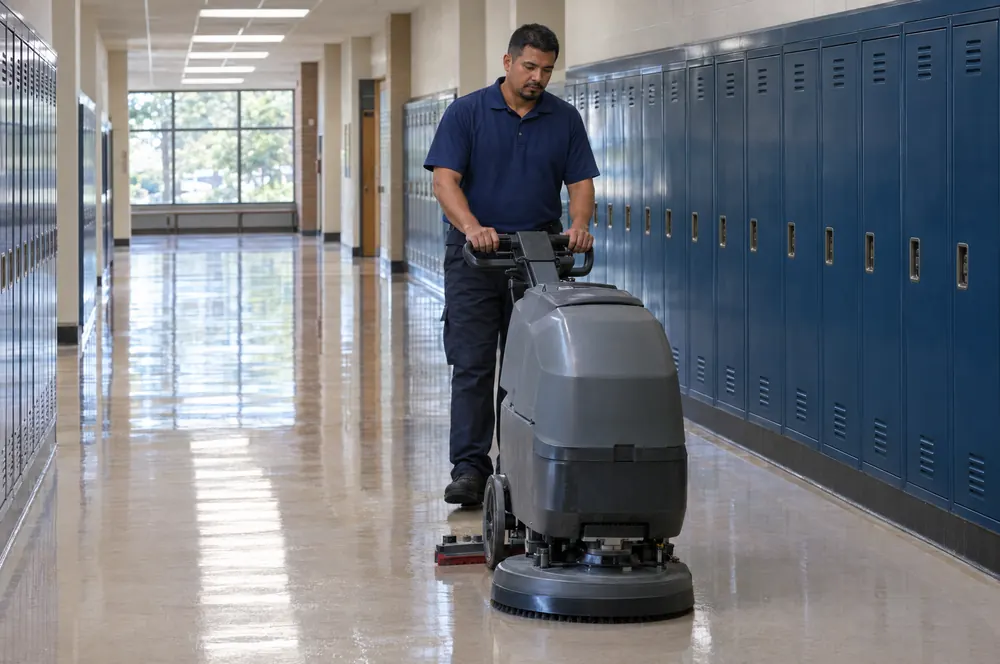
- Summer projects. Many districts save floor stripping, refinishing and carpet extraction for the weeks when classrooms are empty. That's heavier chemical and machine work, often with extra seasonal staff.
- Hiring and screening. Districts and states set background-check rules for people who work around students. Underwriters and buyers both ask how you screen and supervise.
Example scenario: the hallway in July
A crew strips the corridor floors in a middle school during summer break. Slurry from the stripper runs under a door and soaks the bottom of the library carpet and a row of low shelves. The corridor floor your crew was treating may fall under the standard exclusion for the part of a building you were working on. The library carpet and shelving sat outside that area, which is usually where general liability matters.
Example scenario: the cart left at dismissal
At 3:10 p.m., a day custodian steps into a classroom and leaves her cart in the hall. A sixth grader picks up a spray bottle of diluted cleaner and sprays a classmate in the face. The parents' claim for the eye injury would normally go to your general liability policy. Depending on the policy's pollution wording and your state's courts, a chemical injury can raise questions that a slip claim doesn't.
Example scenario: the gym in August
A seasonal worker hired for summer projects climbs a ladder to dust the top of a gym's folding bleachers. The ladder slides on a freshly finished floor, and he breaks his arm. His medical bills and lost wages would usually go to your workers' comp policy. Because he was hired for six weeks, his payroll may not appear in your original comp estimate at all, which the audit will catch.
The coverage stack districts and campuses expect
Most school solicitations list the same core policies. The bond and the umbrella are where they differ most.
General liability
Answers injury and damage claims from students, staff and visitors, and is where additional insured wording for the district lives. General liability for cleaning companies
Workers' comp
Proof of comp, with employer's liability limits, is a standard line in public custodial contracts. Workers' comp for cleaning crews
Janitorial bonds
Some solicitations ask for a fidelity bond in a set amount, and some public contracts name large ones. Janitorial bonds
Commercial auto
Supervisors driving between campuses and crews in their own cars bring auto and hired and non-owned auto into the exhibit. Commercial auto for cleaning companies
Umbrella
Extra limits above your liability policies when the exhibit names a figure your base policies don't reach. Umbrella insurance
Equipment
Auto-scrubbers and extractors stored in a school's custodial closet over the summer usually belong on an equipment floater. Equipment coverage
What school districts and colleges ask for
The dollar limits in school solicitations look a lot alike. The umbrella, the bond and the endorsement wording are what change from one to the next. One Texas college's 2026 custodial exhibit gives a sense of the detail you'll see:
- general liability at $1 million each occurrence, $2 million general aggregate and a $2 million products-completed operations aggregate
- auto liability at $1 million combined single limit
- workers' comp with employer's liability
- a $1 million umbrella
- an employee dishonesty or fidelity bond of $500,000
A bond that size is usually met with a crime policy that includes clients' property coverage, not a small janitorial bond. Ask the buyer in writing whether that satisfies the requirement.
Background checks by state
Screening rules for contractor staff differ widely. A few examples from our state research:
- Texas: contractor employees with continuing duties and direct contact with students must undergo a national criminal history review.
- Ohio: a contractor's employee providing essential school services in a job with routine interaction with children needs a criminal records check from the five years before starting, unless a school employee stays with the children during that contact.
- Pennsylvania: contractor employees with direct contact with children need the state police, child abuse and FBI fingerprint clearances.
- New Jersey: the screening statute names custodians and maintenance workers among the positions that need a criminal history check, including under contracts for services.
- Florida: contractor staff allowed on school grounds while students are present generally need a fingerprint-based state and federal check, with exemptions such as direct supervision by a screened employee. Contractors cleared under the no-direct-contact rule get a statewide photo ID badge.
Illinois, Arizona, California and New York have their own contractor screening rules. Kentucky dropped its statewide check requirement for school contractors in 2019, so there the district's contract usually sets the terms. Read the solicitation first, then confirm with the state education agency.
Growing into school and campus contracts
Few companies start with a district-wide award. The usual path runs through smaller wins that prove you can handle the paperwork.
- A summer floor project. Strip and refinish work at one or two schools gets you on a district's vendor list and tests your crews against its rules.
- A charter or private school. These often have shorter exhibits and a single building to learn on.
- A district or college contract. Expect the full exhibit, a background-check process for every crew member and a start date that won't move.
- Multiple campuses. More buildings bring more supervisors driving between sites, higher limits and a larger bond.
In Texas, most private employers may choose not to carry comp, but public custodial exhibits often list comp with employer's liability limits anyway. The Texas college exhibit above set employer's liability at $500,000 per accident. If you bid public work there, read that line before you decide to go without.
Your price depends on the payroll in each class code, your annual sales, the kinds of buildings you clean, how much specialty and chemical work you do, the vehicles your crews drive, your claims history and the limits your contracts require.
School contracts often run several years, but your policies renew every year. Each renewal means new certificates and, often, new copies of the endorsements uploaded to the district's vendor system. A lapsed certificate can stop payment on an invoice even when your coverage never changed, so put the district's renewal paperwork on the same calendar as your policy dates.
Send us the solicitation's insurance section as soon as you decide to bid. Q&A deadlines are the time to raise a requirement you can't meet. Get a quote for your cleaning business →
School cleaning insurance questions
Do school cleaning contractors need background checks?
What insurance limits do school districts require for janitorial contracts?
Does a school custodial contract require a janitorial bond?
Can my regular policy cover summer floor stripping at schools?
Do I need workers' comp to clean schools in Texas?
Related guides
Ready to see what you'd pay?
Independent agents, 12+ A-rated carriers, and a licensed agent back to you within one business day.