
Home › Coverages › Medical Office & Clinic Cleaning Insurance
Insurance for medical office and clinic cleaning
Medical office cleaning insurance starts with the same general liability, bond and workers' comp any janitorial company carries, then gets tested by sharps, stronger disinfectants and stricter vendor terms. Here's how underwriters look at clinic, dental and urgent care accounts, and what practice managers usually ask you to prove.
- Since 2003
- 12+ A-rated carriers
- 28 states
- Independent agents
Start your cleaning business insurance quote
Takes about two minutes. A licensed agent follows up.
Licensed in 28 states · NPN 7642818 · Since 2003
How underwriters see medical office cleaning insurance
To an underwriter, a medical office is an office building with three extra questions attached: what your crew might touch, what your crew might damage, and what your crew might take. The core policies don't change. The answers to those questions change the price, the endorsements and sometimes the carrier.
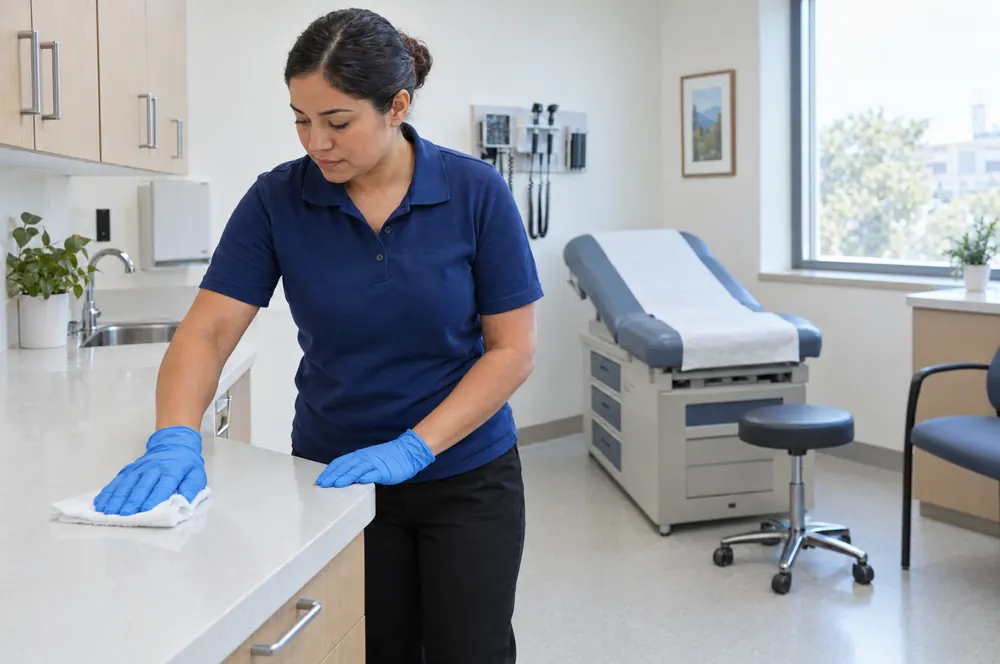
We focus on the work most cleaning companies actually do in healthcare: medical and dental offices, outpatient clinics, physical therapy suites and urgent care centers. A typical night clean covers waiting rooms, exam rooms, restrooms, break rooms and the front desk. Some accounts add a day porter who handles restroom checks and spills while patients are in the building.
Here's what tends to stand out on an application:
- Disinfectant use. Clinics often specify EPA-registered disinfectants and the label's dwell time. More product, more often, means more chance of a splash injury or a damaged surface.
- Sharps and body fluids. Sharps can turn up where they don't belong, like a loose needle in an exam-room trash bag.
- Expensive things in small rooms. Exam tables, dental chairs, monitors, check-in kiosks and imaging equipment sit inches from your spray bottles.
- Controlled spaces. Sample closets, records rooms and alarm codes make key control and hiring practices part of the conversation.
- Patients on the floor. People using walkers, canes and wheelchairs cross the same floors your porter is mopping.
Example scenario: the trash bag in exam room four
A crew member at a family practice pulls a bag from an exam-room bin at 8:15 p.m. A syringe someone dropped in the regular trash goes through the plastic and into her thigh. Her clinic visit, follow-up testing and any lost shifts would usually go to your workers' comp policy. The practice will also want to know how your crew is trained to handle trash in clinical rooms.
Example scenario: the kiosk that stopped working
A two-person crew wipes down a dental office's touchscreen check-in kiosk with a spray disinfectant on a Thursday night. Liquid runs behind the bezel, and the kiosk won't boot the next morning. The practice sends a replacement invoice. Because the crew was cleaning that exact item, standard liability exclusions for property in your care, and for the property you were working on, may limit what your policy pays.
Example scenario: the sample closet comes up short
An urgent care manager tells you two cartons of medication samples are missing after a weekend clean. Nobody saw anything, and no one has been charged. A janitorial bond often requires a conviction before it pays. A crime policy with clients' property coverage doesn't, but it usually requires that the employee be identified. Until that happens, the practice may simply hold back your invoice.
The coverage stack for clinic and dental accounts
Most cleaning companies that serve medical offices carry the same core policies as an office-cleaning route. The difference is how much weight each one carries.
General liability
Answers injury and damage claims from patients, staff and the practice. Ask how the policy handles the item your crew was cleaning. General liability for cleaning companies
Workers' comp
Needlesticks, chemical splashes and back strains from heavy trash are crew injuries, and comp is where they usually land. Workers' comp for cleaning crews
Janitorial bonds
Some practices ask whether you're bonded before they hand over keys and alarm codes. Janitorial bonds
Employee dishonesty and crime
Protects your own money, and with clients' property coverage can respond when a client's property disappears. Crime coverage for cleaning companies
Client property and lost keys
Optional add-ons can buy back some damage to property in your care and pay to re-key a suite. Client property and lost key coverage
Pollution and chemical liability
Disinfectant fumes or a mixing incident in a small, closed suite can run into a pollution exclusion. Chemical liability coverage
What practice managers and clinic groups ask you to prove
A single dental office may want nothing more than a certificate. A clinic group with a dozen locations usually sends a vendor packet. Expect some mix of these:
- Liability limits. Published janitorial solicitations commonly start at $1 million per occurrence with a $2 million aggregate, and larger groups may ask for an umbrella on top.
- Additional insured status for the practice, the management company or both, sometimes with primary and non-contributory language and a subrogation waiver attached. Those come from endorsements on the policy, not from the certificate that summarizes it.
- A janitorial bond in a stated amount, because your crew works alone among records and medication.
- Background checks for anyone assigned to the building, and sometimes a named, stable crew.
- Training records. Some practices ask to see hazard communication training and, where it applies, bloodborne pathogens training.
- Your disinfectant list. Product names and EPA registration numbers, so the practice can match them to its infection-control plan.
In California, one wage rule deserves a look. The Labor Commissioner lists janitorial work as a service supporting health care, so a contractor's crew at a covered health care facility can fall under the health care minimum wage. That happens when the facility acts as a joint employer, or when a worker spends more than half of a workweek at the covered facility. Higher wages mean more rated payroll for comp. Check the rule with the Labor Commissioner or your attorney.
Our guide to contract insurance requirements shows how to read a vendor exhibit line by line. Get a quote for your cleaning business →
Growing a medical cleaning route
Most companies get into this segment one practice at a time. A dentist who rents in an office park you already clean asks for a quote. Then a physical therapy group with four locations calls. Each step changes something on your policies.
- Your first clinic. Tell your carrier. A route that was all office suites now includes a different kind of facility, and your application should say so.
- A day porter. Daytime work puts your staff in front of patients. Slip claims, and the wording on who must be named as additional insured, matter more.
- A clinic group. Multi-location contracts often bring higher limits, a bigger bond and a vendor portal that rejects a certificate missing any endorsement.
- More payroll. Comp is priced on payroll, so update your estimate when you add a group of buildings rather than waiting for the audit.
Your price depends on the payroll in each class code, your annual sales, the kinds of buildings you clean, how much specialty and chemical work you do, the vehicles your crews drive, your claims history and the limits your contracts require.
Lining up the bond, endorsements and limits before you submit the bid is far easier than adjusting them after you win. Get a quote for your cleaning business →
Medical office cleaning insurance questions
Do I need special insurance to clean medical offices?
Is a needlestick injury to my cleaner covered?
Do medical office cleaners need bloodborne pathogens training?
Does a dental office require a janitorial bond?
What if our disinfectant damages a clinic's equipment?
Related pages
Ready to see what you'd pay?
Independent agents, 12+ A-rated carriers, and a licensed agent back to you within one business day.