
Home › Coverages › General Liability Insurance for Cleaning Businesses
General liability insurance for cleaning businesses
General liability insurance for a cleaning business pays to defend and settle claims that your crews hurt someone outside your company or damaged property that isn't yours, from a tenant's fall on a wet corridor to a bleach spot on a client's carpet. How much it actually pays depends on three things most quotes don't explain: the exclusions for property you're working on, the pollution wording and the limits your contracts name.
- Since 2003
- 12+ A-rated carriers
- 28 states
- Independent agents
Start your cleaning business insurance quote
Takes about two minutes. A licensed agent follows up.
Licensed in 28 states · NPN 7642818 · Since 2003
What general liability insurance does for a cleaning business
General liability (GL) is the policy that answers when someone who doesn't work for you says your company injured them or damaged their property. It pays for your legal defense and, if the claim is covered, the settlement or judgment. Most contractor GL uses an occurrence trigger. Coverage comes from whichever policy was active the night someone got hurt, even when the suit is filed two years later.
Nearly every shift you work happens inside a building someone else owns, so janitorial GL claims tend to come from five places:
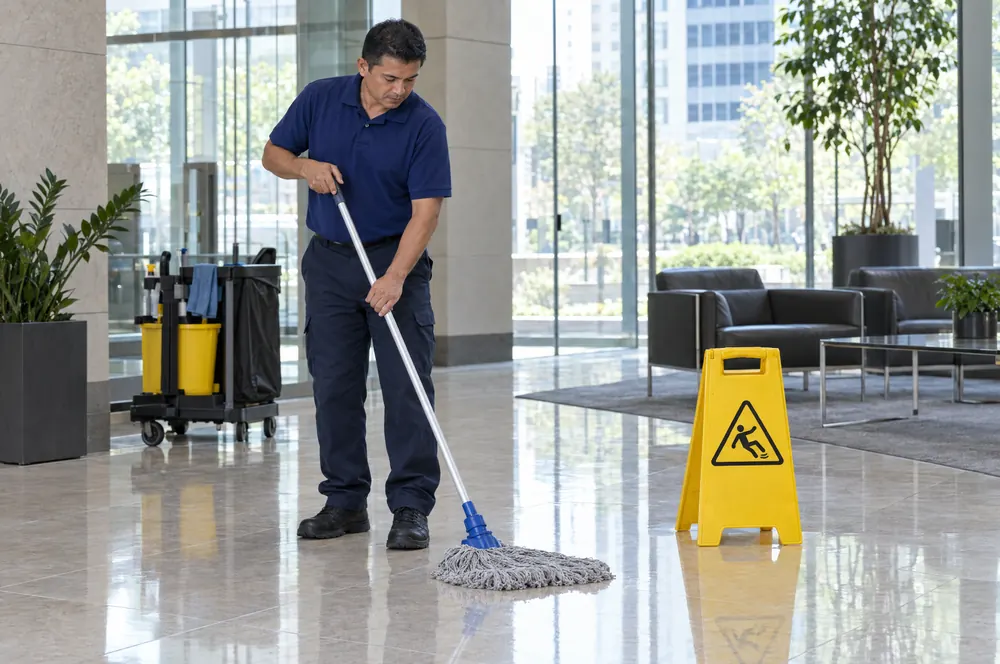
- Floors. Wet or freshly finished floors, and whether the signs and cones were where they belonged. One specialty carrier's janitorial claim sheet describes a delivery driver who fell on a store floor being mopped before opening, with no signs or cones out.
- Surfaces. An acid bowl cleaner that etches marble or terrazzo, a chlorine product that spots stainless steel or bleaches carpet, a stripper that lifts a wood finish, a pad that scratches a glass door.
- Machines. An auto-scrubber or burnisher that gouges a wall, a door frame or an elevator cab.
- Water. A mop sink left running, or an extractor hose that floods the tenant space below.
- Gear in the way. A cart parked in a doorway, a sign that tips over, a vacuum cord across a corridor.
Whether a given claim is paid still depends on your policy wording and the facts.
How carriers classify your work
Carriers typically rate commercial janitorial work under ISO general liability class 96816, Janitorial Services. Carpet, rug, furniture or upholstery cleaning on customers' premises (91405) and floor waxing (94590) have classes of their own when a carrier rates them separately. Your carrier assigns the class, and some use their own class plans.
Where your contracts lean on GL
The insurance exhibit in a cleaning contract is mostly a list of GL demands: limits, a products-completed operations aggregate and endorsements that make the client an additional insured. Our guide to what cleaning contracts require walks through each line. Get a quote for your cleaning business →
What cleaning business liability insurance covers, and what it usually doesn't
| What GL can pay for | Where it usually stops |
|---|---|
| A visitor, tenant or client employee hurt by your work, such as a fall on a floor your porter just mopped | Injuries to your own crew members, which belong on workers' comp |
| A tenant's things damaged by your work, like a copier soaked by water from your mop sink | Damage to the particular part of a building your crew was working on when it happened |
| Parts of a client's building beyond the surface you were working on, like a door frame your scrubber clipped | Personal property in your care, custody or control, like the monitor you lifted to wipe a desk |
| Legal defense when a covered claim turns into a lawsuit | Theft by your own employees, which points to a janitorial bond or crime coverage |
| Injury or damage after a building's work is finished, under the products-completed operations limit | Your own floor machines and supplies, which need an equipment floater |
| Clients added as additional insureds, when the policy is endorsed to do it | Many fume, spill and fungi or bacteria claims, depending on the pollution and fungi wording |
| Personal and advertising injury, such as a claim that your marketing defamed a competitor | Harassment and discrimination claims, which point to employment practices liability |
| Small medical bills for an injured visitor regardless of fault, if your policy includes medical payments | Re-keying a building after your crew loses its keys, which takes an add-on |
Three janitorial liability claims, three different answers
One policy can answer three incidents three ways, depending on what got damaged and when. These fictional examples show where the lines fall.
Example scenario: the mop sink on the second floor
At 12:40 a.m., a crew member at a two-story accounting office fills a bucket, gets called to the loading dock and forgets the faucet. By 6 a.m. water has come through the ceiling tiles of the ground-floor suite, soaking carpet, a copier and two workstations. None of that was the surface your crew was cleaning, so it's the kind of property damage GL is meant to answer, subject to your policy terms.
Example scenario: the scrubber and the elevator doors
At 4:15 a.m., a floor tech runs a walk-behind auto-scrubber across a corporate lobby. Turning too wide, he clips the brushed-steel elevator doors and the stone door frame beside them. The lobby floor was the part he was working on, but the doors and frame weren't. That difference can decide whether the exclusion for property you're working on comes into play.
Example scenario: Monday morning at the bank branch
Your crew strips and recoats a bank branch's vinyl floor on a Saturday night and leaves at 2 a.m. On Monday at 9:05, a customer slips near the teller line where the finish was left uneven. Because the work was done and the branch was back in use, this claim can fall under products-completed operations, which has its own aggregate limit on your policy.
What general liability costs a cleaning company
Published janitorial GL prices for small companies run in the tens of dollars a month. Three online sellers report these figures for their own customers:
| Source | What it reports | Keep in mind |
|---|---|---|
| One online insurance marketplace (cleaning businesses, updated October 2026) | About $59 a month ($705 a year), which it says reflects the median policy | Most of its customers have fewer than five employees |
| One online insurer (janitorial, data updated October 2026) | Typically $20 to $50 a month; about half its customers pay $38 to $50 | Its policies run from $300,000 to $1 million per occurrence |
| A second online marketplace (janitorial, updated September 2026) | About $42 a month, which it calls a median | Based on policies its janitor customers bought from July to December 2024 |
Your price depends on the payroll in each class code, your annual sales, the kinds of buildings you clean, how much specialty and chemical work you do, the vehicles your crews drive, your claims history and the limits your contracts require.
Treat those numbers as a floor. A 40-person contractor with $1 million / $2 million limits and blanket additional insured wording can expect to pay well above them. Your work mix counts too: one specialty carrier's janitorial program accepts floor waxing up to half of the work and caps side services like carpet and window cleaning at half of sales. Our cost guide covers every policy you'll price. Get a quote for your cleaning business →
Who needs janitorial liability insurance most
Any cleaning company with a commercial client needs GL; few property managers hand over keys without a certificate. Some accounts push the limits and wording harder:
- Multi-tenant offices, where day porters work around tenants all day. See office cleaning insurance.
- Medical offices and clinics, with heavier disinfectant use. See medical facility cleaning insurance.
- Schools and campuses, where public owners spell out limits in the bid. See school cleaning insurance.
- Floor care and carpet services, which raise the stakes on every surface. See specialty cleaning insurance.
New companies usually buy GL before any other policy. Get a quote for your cleaning business →
State rules that shape a slip-and-fall claim
Your policy reads the same everywhere, but the law that decides a fall case doesn't. In many states, a tenant who ignored your wet-floor sign can still collect part of the loss.
- Texas bars a claimant only when their share of responsibility is greater than 50%. Texas cleaning insurance
- Ohio bars recovery only when the claimant's fault is greater than everyone else's combined. Ohio cleaning insurance
- New York and Arizona use pure comparative fault in a fall case like this: the claimant's carelessness shrinks the award but never erases it. New York cleaning insurance
- Florida has a statute for slips on a "transitory foreign substance" in a business: the injured person must prove the business had actual or constructive knowledge of the dangerous condition. In negligence suits filed after March 24, 2023, an injured person whose own share of fault is over 50% recovers nothing. Mopping schedules and sign placement can become evidence. Florida cleaning insurance
These rules shape claims, not coverage. For your own case, talk to an attorney.
Related coverage for cleaning companies
General liability questions from cleaning company owners
Do I need general liability insurance for my cleaning business if no client has asked for it yet?
Does general liability cover damage to a floor we were stripping?
Does my GL policy cover my cleaners if they get hurt on the job?
How much liability insurance does a janitorial company need?
Will general liability pay if one of my cleaners steals from a client?
Is janitorial liability insurance different from general liability?
Ready to see what you'd pay?
Independent agents, 12+ A-rated carriers, and a licensed agent back to you within one business day.