
Home › Coverages › Cleaning Equipment Insurance
Cleaning equipment and tools insurance
Contractors equipment insurance, usually written as an inland marine floater, pays to repair or replace your floor machines, extractors and backpack vacuums when they're stolen or damaged. For a cleaning company, its real job is covering the machines you keep in a janitor's closet at a client's building, where property coverage built around your own address usually stops.
- Since 2003
- 12+ A-rated carriers
- 28 states
- Independent agents
Start your cleaning business insurance quote
Takes about two minutes. A licensed agent follows up.
Licensed in 28 states · NPN 7642818 · Since 2003
What contractors equipment insurance covers for a cleaning company
A contractor's equipment floater (also called a tools and equipment policy) is a type of inland marine insurance. It travels with your gear from the shop to the van to the account, and when a covered machine is stolen or broken, it pays for the repair or a replacement. "Floater" just means the coverage moves with the property instead of staying at one address.
For a cleaning company, the list usually includes:
- Floor machines: walk-behind and ride-on auto-scrubbers, burnishers and swing machines
- Carpet extractors and their wands and hoses
- Backpack and upright vacuums and wet/dry vacs
- Janitor carts and other portable gear you own or rent
The floater exists because your other policies don't reach this gear. General liability answers for harm your crew causes to a client's building or a tenant's things, never your own machines. Commercial auto stops at the vehicle and whatever is fastened to it, so a burnisher sliding around the cargo area isn't part of it.
The closet at the client's building
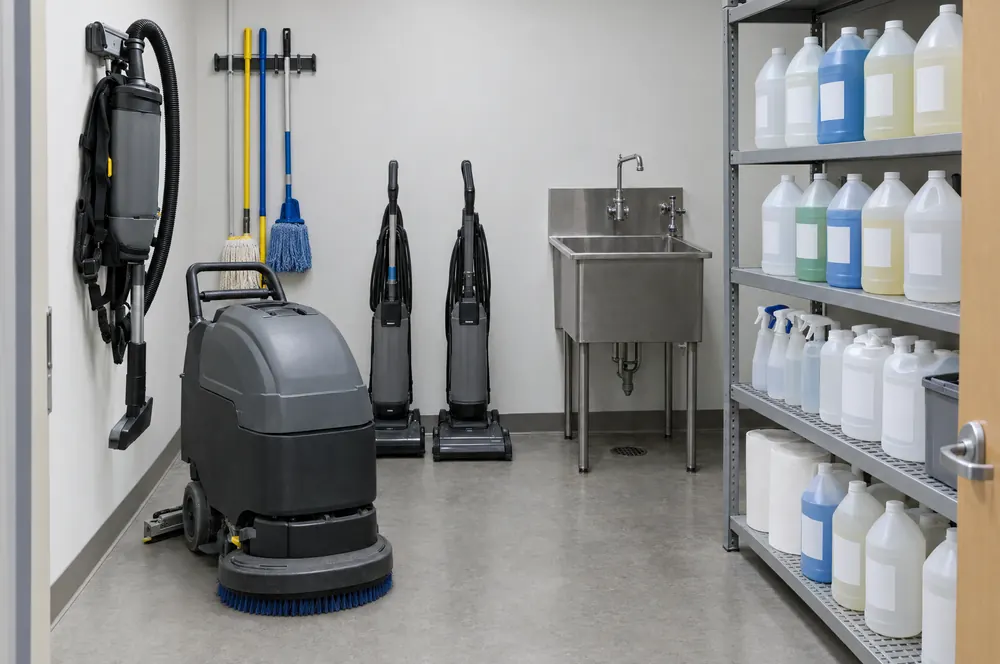
Cleaning companies store a lot of equipment where the work is. Auto-scrubbers, burnishers and extractors often live in a janitor's closet at the account so the night crew doesn't haul them in and out. Property coverage in a business owner's policy is built around your own premises, so machines kept at clients' buildings usually belong on a floater.
One specialty carrier's janitorial program describes exactly this kind of loss: a vacuum kept in a client's hallway was destroyed by a fire there, and the contractor filed a claim to replace it, listed under the program's equipment floater.
Scheduled or blanket
Floaters cover equipment two ways. Scheduled items are listed one by one, with a serial number and a value. Blanket coverage pays up to a set amount for unlisted tools and small gear. Most cleaning companies use both: a schedule for the big machines and a blanket limit for vacuums and hand equipment.
Rented and borrowed machines
A standard contractor's equipment form can cover other people's equipment in your care, custody or control, such as rented or borrowed machines, when it's scheduled or reported. Rental reimbursement, where it's included, covers the cost of renting a substitute while your own covered machine can't be used. Compare that with the damage waiver the rental company offers.
| Often covered, depending on the floater | Usually not covered here |
|---|---|
| Theft of covered machines from your shop, van or a client's building, subject to the theft conditions | Items that simply go missing with no sign of theft ("mysterious disappearance") |
| Fire, collapse or accident damage to machines at an account or in transit | Damage your machine does to a client's floor or wall, which is a liability question |
| Rented or borrowed machines, when scheduled or reported | Racks and shelving bolted into the van, which the auto policy covers |
| A stand-in rental while yours is repaired, if rental reimbursement is included | Theft from an unlocked van with no forced entry, on some forms |
How equipment losses happen on a cleaning route
Example scenario: the shared closet
Your crew keeps two backpack vacuums and a carpet extractor in a closet at a suburban office park. The building's engineers share the closet. Over a holiday weekend, someone pries the door and walks out with all three. With a police report and signs of forced entry, a floater that covers equipment at client locations is where the claim would typically go.
Example scenario: the 3 a.m. stop
Between two buildings, a night crew stops at an all-night gas station. The van is locked, but someone smashes a side window and takes a burnisher. Some floaters require two things before they'll pay for theft out of a parked, empty vehicle: the doors and windows were closed and locked, and the break-in left visible signs of forced entry. Both are true here, so the claim can move forward, subject to your deductible.
Example scenario: the ramp at the distribution center
At 10 p.m., a ride-on auto-scrubber rolls off a loading ramp during unloading at a distribution center and cracks its frame. The repair bill is well above the $5,000 blanket limit on the company's floater, because the machine was never scheduled. The company also rents a replacement for two weeks to keep the account running.
What equipment coverage costs a cleaning company
Equipment coverage is usually one of the smaller lines on a cleaning company's bill. What moves the price is the total value you schedule, the blanket limit, your deductible, where the machines are stored and your theft history. Published figures come from small accounts with modest limits:
| Source | Figure | What it measures |
|---|---|---|
| One online insurer (data updated October 2026) | About $30/month on average | What it says 77% of its janitorial customers pay for tools and equipment coverage |
| One online insurance marketplace (updated September 2026) | $21/month ($252/year) | Median for its janitor customers' policies bought July to December 2024 |
A schedule of ride-on scrubbers and extractors will cost more. Your price depends on the payroll in each class code, your annual sales, the kinds of buildings you clean, how much specialty and chemical work you do, the vehicles your crews drive, your claims history and the limits your contracts require. The cleaning insurance cost guide shows how equipment fits next to liability, comp and auto.
Which cleaning companies need equipment coverage most
Companies that store machines at accounts. If your auto-scrubbers live in client closets, a floater is often the only policy that follows them there.
Companies with ride-on or high-value machines. One ride-on scrubber can outrun a small blanket limit by itself. Schedule it.
Companies that sell floor care and carpet extraction. Strip-and-wax crews and extraction add-ons bring more and costlier machines. Our specialty cleaning insurance page covers those services.
Contractors on plant and warehouse accounts. Bigger floors mean bigger machines, often moved between loading docks and freight elevators. See industrial cleaning insurance.
Companies that rent machines for projects. Make sure rented equipment is scheduled or reported before it leaves the rental yard.
State notes on cleaning equipment
Texas. San Antonio's 2023 custodial solicitation for city facilities required the contractor to furnish all cleaning supplies and commercial equipment. City-scale work like that means a lot of company-owned machines spread across many buildings. See the Texas commercial cleaning insurance page.
California and Georgia. In both states, sales tax generally doesn't apply to a cleaning company's service fees, but the company pays tax on the equipment and supplies it buys for its own use. Set scheduled values at what it would cost to replace the machine, tax included. See the California and Georgia pages.
Related coverage
Equipment questions from cleaning company owners
Does general liability cover my cleaning equipment?
Is my floor scrubber covered if it's stolen from a client's building?
What is inland marine insurance for a cleaning business?
Are rented floor machines covered?
Should I schedule my equipment or use a blanket limit?
Ready to see what you'd pay?
Independent agents, 12+ A-rated carriers, and a licensed agent back to you within one business day.