
Home › Coverages › Commercial Auto Insurance for Cleaning Companies
Commercial auto insurance for cleaning companies
Commercial auto insurance covers the vans and route vehicles your cleaning company owns, and hired and non-owned auto insurance covers your company's liability when crew members drive their own cars between client buildings. Many janitorial contracts ask for auto liability that includes both, often at $1 million.
- Since 2003
- 12+ A-rated carriers
- 28 states
- Independent agents
Start your cleaning business insurance quote
Takes about two minutes. A licensed agent follows up.
Licensed in 28 states · NPN 7642818 · Since 2003
Hired and non-owned auto insurance and commercial auto for cleaning crews
A cleaning company's driving comes in three kinds, and each one needs a different piece of the auto policy.
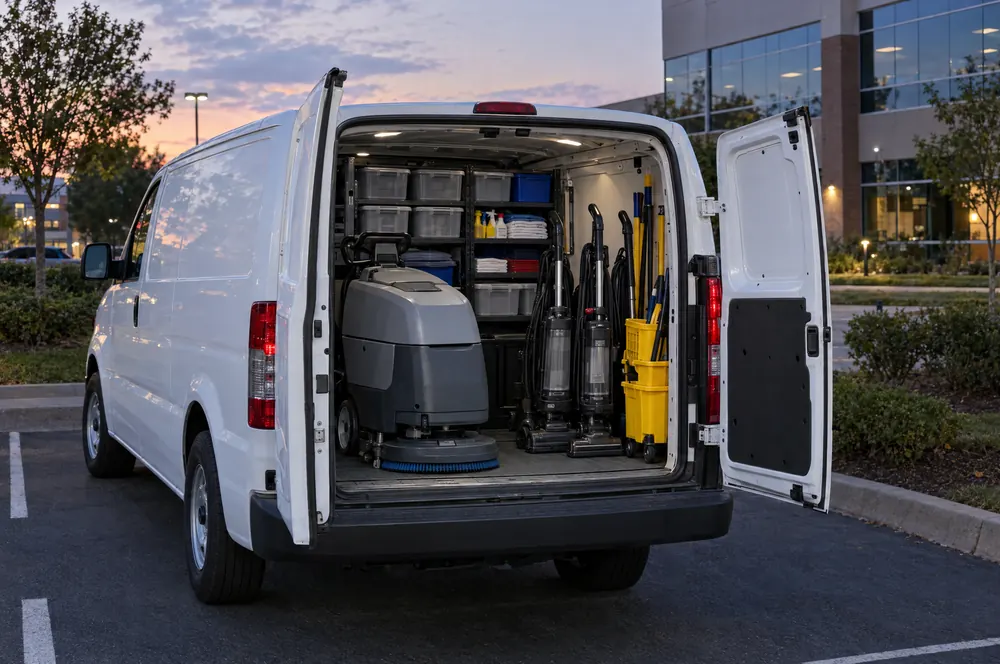
Vans the company owns. A cargo van titled to the business that carries crews, floor machines and chemicals belongs on a commercial auto policy. Personal auto policies may limit or exclude business use, which is a poor surprise to find after a crash.
Cars your people own. Porters, route supervisors and part-time night cleaners often drive their own cars between buildings, to the supply house or to pick up a coworker. If one of them causes a crash on company business, the injured driver can name your company in the suit. Hired and non-owned auto (HNOA) covers your business's liability for that. The employee's own auto policy usually responds first.
Vehicles you rent or borrow. A van rented for a weekend strip-and-wax project, or a truck borrowed from another business to move machines to a new account, falls under the "hired" half of HNOA for liability. Vehicles borrowed from your own employees count as non-owned instead.
On the standard ISO business auto form, these show up as numbered symbols on your declarations page. Symbol 8 covers hired autos and symbol 9 covers non-owned autos. When a contract asks for "owned, hired and non-owned" auto liability, those symbols are what the certificate reader looks for.
What rides in the van
Auto covers the vehicle and equipment permanently attached to it, like racks and shelving. A burnisher, carpet extractor or backpack vacuum riding loose in the back is equipment, not part of the auto, and it belongs on cleaning equipment insurance.
Chemicals in transit
Most janitorial chemical loads are small, but some concentrated products, such as certain floor strippers, degreasers and acid restroom cleaners, can be regulated hazardous materials in transport. Federal rules give businesses a "materials of trade" exception for limited amounts carried to support their own work. Under it, a package of a Packing Group II or III material in a covered class, such as Class 8 corrosives, can weigh or hold up to 30 kg (66 lb) or 30 L (8 gal); Packing Group I materials are limited to 0.5 kg (1 lb) or 0.5 L (1 pint). The total weight of all materials of trade on the vehicle generally can't exceed 200 kg (440 lb). Containers must be leak tight, securely closed, secured against shifting and marked with a common name or proper shipping name for the contents.
We don't give DOT compliance advice. A product's safety data sheet, in Section 14, usually lists its transport classification, and 49 CFR 173.6 has the rule itself. From an insurance view, an unsecured jug that splits in a crash or a hot van can hurt people and damage property, and a rule violation can complicate the claim. Chemical incidents inside a client's building are a separate topic, covered on our pollution liability page.
| Usually covered | Usually not covered by auto |
|---|---|
| Injury and damage your company vans cause to others in a crash | Repairs to an employee's own car, since HNOA covers only your company's liability |
| Your company's liability when staff drive personal cars for work (non-owned auto) | Floor machines, extractors and vacuums riding loose in the van |
| Your liability while driving rented or borrowed vehicles for business (hired auto) | Your own crew's injuries in a crash, which usually go to workers' comp |
| Physical damage to owned vans and their attached racks, if you buy comprehensive and collision | A van titled and insured personally but used mostly for the business |
How auto claims start on a cleaning route
Example scenario: the 4 a.m. intersection
A route supervisor finishes checking a call center at 3:45 a.m. and drives his own SUV toward a credit union branch for a key handoff. He runs a late yellow light and hits a delivery driver. His personal auto insurer handles the claim first. The delivery driver's lawyer also sues your company because the supervisor was on the clock. Non-owned auto coverage is where that suit against your business usually goes.
Example scenario: the rented van and the loading dock
For a two-weekend floor project at a distribution center, you rent a cargo van to haul extra machines. On Sunday evening a crew member backs it into the dock's steel canopy and bends a support. The damage to the canopy is a liability claim, and hired auto coverage is built for it. Damage to the rental itself is a separate question, so ask us how your policy treats it before you sign at the rental counter.
Example scenario: the parking garage sideswipe
At 10 p.m., your van scrapes a tenant's parked car while turning tight in an office building's garage. The impact also tips the burnisher in the back, cracking its housing. The tenant's car falls under your commercial auto liability. The burnisher doesn't, and it would need an equipment floater to be repaired or replaced.
What commercial auto costs a cleaning company
Auto is often one of the larger lines on a cleaning company's bill, because crews and supervisors drive at night between many buildings. The number and type of vans, where they're kept, who drives them and those drivers' records all shape the price.
| Source | Figure | What it measures |
|---|---|---|
| One online insurance marketplace (updated October 2026) | $250/month ($3,001/year) | Commercial auto premium for its cleaning-business customers, based on the median policy |
| Progressive Commercial (2025) | $260/month per vehicle | National average for new contractor-auto policies with no driver violations, not cleaning companies alone |
Treat both as rough reference points from small-business customers. Your price depends on the payroll in each class code, your annual sales, the kinds of buildings you clean, how much specialty and chemical work you do, the vehicles your crews drive, your claims history and the limits your contracts require. See the cleaning insurance cost guide for how auto fits with the rest of a bid.
Which cleaning companies need auto coverage most
The owner-operator with one van. The day the van starts carrying a crew and a scrubber to accounts, it's working for the business and should be insured that way.
Companies whose crews drive their own cars. This gap is easy to miss. Part-time night cleaners driving between two or three buildings a shift create non-owned auto exposure even if the company owns no vehicles at all.
Contractors bidding public and campus work. Public janitorial solicitations commonly spell out auto liability "owned, non-owned and hired" at $1 million. Our guide to contract insurance requirements walks through the full exhibit.
Growing companies. Crash severity, with crews driving between buildings at night, is one of the usual reasons a cleaning company's limits get pushed up, often with an umbrella policy on top.
State notes on auto for cleaning contractors
Ohio. One township's 2026 janitorial RFP asked for $1 million auto liability covering owned, non-owned and hired vehicles, plus a $2 million umbrella. See the Ohio commercial cleaning insurance page.
Connecticut. A 2022 town custodial RFP asked for $2 million in auto liability, double the common $1 million, along with a $2 million umbrella. See the Connecticut commercial cleaning insurance page.
Texas. TxDOT counted 3,769 traffic deaths statewide in 2025, based on crash reports processed as of April 7, 2026. A 2026 college janitorial exhibit there asked for $1 million auto covering owned, non-owned, leased and hired vehicles if vehicles are used in connection with the services. See the Texas commercial cleaning insurance page.
Indiana and Colorado. Universities in both states ask vendors for $1 million auto, worded as "any auto" or as owned, hired and non-owned. See the Indiana commercial cleaning insurance page.
Georgia. A 2025 tort reform law changed how auto cases are tried, including letting juries hear seatbelt-use evidence. See the Georgia commercial cleaning insurance page.
Related coverage
Auto questions from cleaning company owners
Do I need commercial auto if my cleaners drive their own cars?
What is hired and non-owned auto insurance for a cleaning business?
Does my auto policy cover the floor machine in my van?
Can I use my personal auto policy for a cleaning van?
Do I need special permits to carry cleaning chemicals in my van?
Ready to see what you'd pay?
Independent agents, 12+ A-rated carriers, and a licensed agent back to you within one business day.